- Phil Neil's Newsletter
- Posts
- How do you lead when uncertainty becomes the default state
How do you lead when uncertainty becomes the default state

Phil Neil
December 16, 2025
“The Unbreakable Founder illustration showing leadership during uncertainty”
The Unbreakable Founder
How Do You Lead When Uncertainty Becomes the Default State?
By the end of 2025, many founders weren’t asking how to grow faster.
They were asking quieter, heavier questions—questions that surface when decision-making under pressure becomes the daily reality.
Why does every decision feel harder than it used to?
Why does momentum no longer feel like progress?
Why am I doing “all the right things” and still feel stretched to the edge?
Against this backdrop,Founder Compass hosted its first LIVE podcast episode on December 11, 2025, at 1:00 PM ET, titled:
“How to Become an Unbreakable Founder in a World of Constant Uncertainty.”

Phil Neil live on Founder Compass discussing founder uncertainty and decision-making under pressure
The session was moderated by PJ Jackson, Chief Transformation Officer at Founders Compass, and led by Phil Neil—tech investor, growth strategist, and former founder who built and exited a company for $70M, before later experiencing a business collapse forcing him to confront a deeper reckoning, something he as a founder never slowed down long enough to examine.
This wasn’t a conversation about tactics.
It wasn’t about grit, hustle, or powering through.
It was about the internal conditions that determine whether a founder can keep making good decisions when pressure doesn’t let up and what happens when those conditions quietly erode.
Before strategy breaks.
Before teams burn out.
Before founders even realize they’re in trouble.
Why Founders Don’t Break All at Once—They Erode Over Time
Phil Neil didn’t describe startup failure as a single bad decision or an unlucky moment.
He described it as a gradual erosion of decision quality—one that happens when founders operate under sustained pressure.“The root cause of startup failure isn’t usually strategy. It’s the degradation of decision quality under pressure.” - Phil Neil
After his exit, Phil went all in on a nanotechnology company with enormous promise. The team spent years navigating post-COVID market shifts, delayed regulations, and repeated pivots. Eventually, the business secured a letter of intent worth hundreds of millions of dollars.
From the outside, success looked inevitable.
Internally, something else was happening.
The team had been sprinting for too long.
Burnout went unspoken.
Urgency replaced reflection.
When technical partners burned out and left—and a warehouse fire destroyed uninsured inventory—the business didn’t fail because the opportunity wasn’t real.
It failed because the human system carrying the business had exceeded its capacity.
Founders are trained to diagnose market problems.
They’re rarely trained to recognize when their own internal operating system is under strain—or how that strain quietly reshapes every decision they make.
That realization led to a deeper question:
What happens inside a founder before the company breaks?
The Shadow of Entrepreneurship
What made Phil’s story resonate wasn’t the scale of the loss or the volatility of the market.
It was how familiar the pattern felt.
The business didn’t collapse in a single moment. It unraveled through a series of reasonable decisions made under growing pressure—each one slightly more reactive than the last.
No one wakes up intending to burn out.
No one consciously chooses lower-quality decisions.
But over time:
Urgency replaces clarity
Action replaces reflection
Internal signals get drowned out by external demands Phil gave definition and a language to name what most founders experience—but rarely name out loud..
He calls it the Shadow of Entrepreneurship.
The Three Emotional Patterns That Break Founders
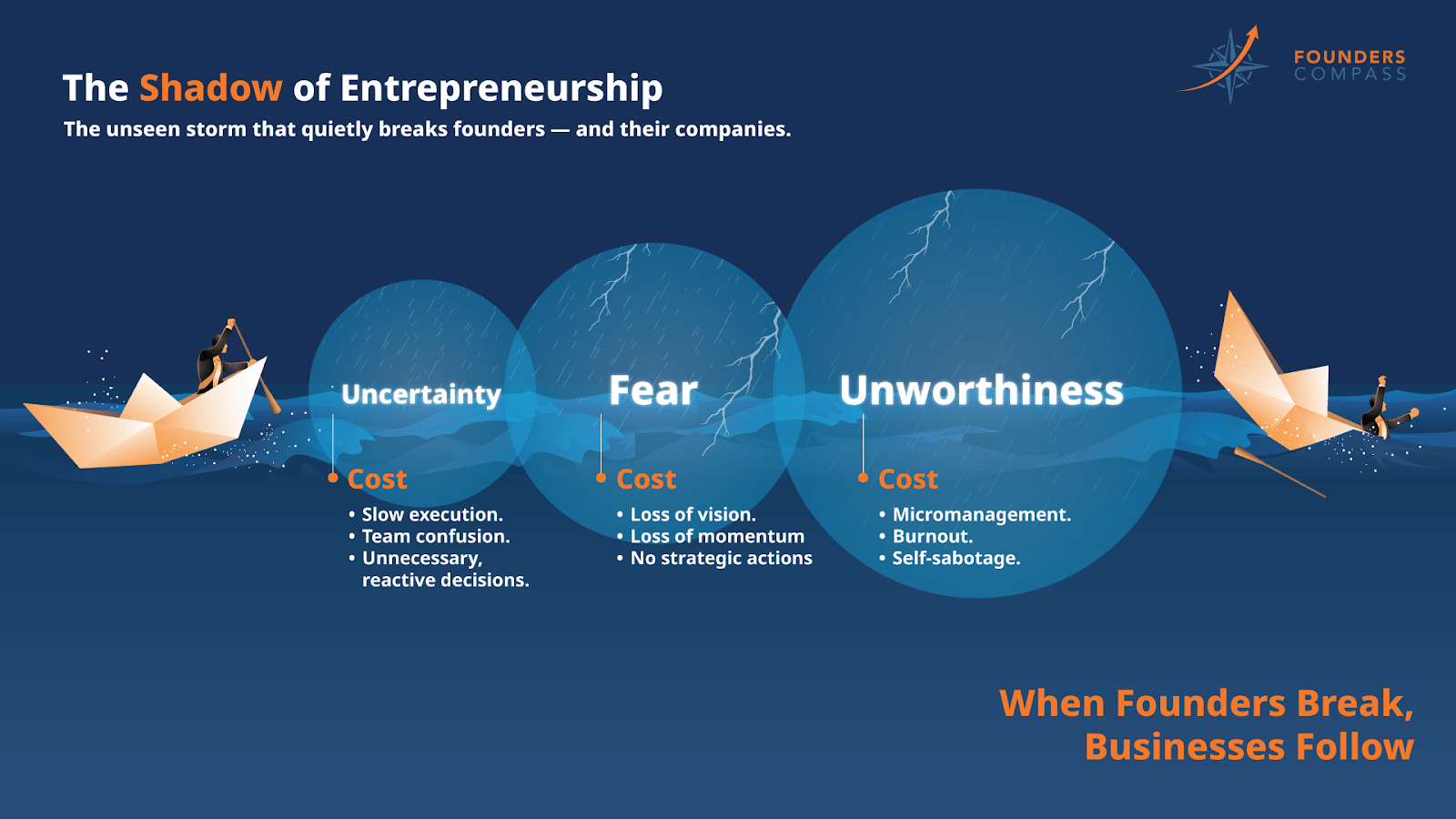
founder burnout emotional cycle
According to Phil, the Shadow of Entrepreneurship is the true first domino in most founder breakdowns.
It’s made up of three interconnected emotional forces that compound under pressure:
Uncertainty
Founders live outside their comfort zone by definition. Markets reject plans. Feedback contradicts vision.
“Founders are constantly bridging two realities—and uncertainty creeps in whether we want it to or not.”
Uncertainty activates the nervous system and pushes founders to seek relief through decisions—often before clarity is available.
Fear
When uncertainty lingers, fear demands action.
“Motion looks like momentum, but it really isn’t.”
Founders begin reacting—over-pivoting, over-hiring, over-consuming advice—mistaking movement for progress.
Unworthiness (Imposter Syndrome)
If fear goes unresolved, it turns inward.
“If you stay too long in fear, you start looking for a reason—and that reason often falls on you.”
This is where burnout, self-blame, and quiet self-sabotage emerge.
Research supports this. Forbes supports these claims, showing that chronic stress significantly reduces executive decision quality—especially in high-uncertainty environments.
Why the Ability to Pause Is a Founder Skill—Not a Luxury
Founders are trained to act.
To move quickly.
To stay ahead.
To respond before the window closes.
But as Phil Neil pointed out during the session, the cost of constant action is rarely visible at the moment. It shows up later when decisions feel heavier, when clarity slips, and when everything starts to feel urgent at once.
One of the most powerful moments of the session wasn’t a framework or a slide.
It was a pause.

PJ teaches breathing exercise for leadership clarity
One of the most powerful moments of the session wasn’t a framework—it was a pause.
PJ Jackson guided the group through a simple breathing exercise she learned and practiced in the Navy, a practice designed to regulate the nervous system before making decisions. The message behind it was simple, but deeply countercultural in startup life:
“If you don’t calm the body first, you’ll never access clarity.” — Phil Neil
This wasn’t framed as self-care.
It was framed as decision hygiene.
When the nervous system is overloaded, founders don’t lose intelligence—they lose access to it.
Decisions become reactive.
Action replaces reflection.
Motion begins to masquerade as progress.
“Entrepreneurship is a marathon, not a 400-meter sprint.”
Pausing, in this context, isn’t slowing the business down.
It’s creating the internal conditions required to lead it well.
Pinnacle Potential advises that self-awareness and emotional regulation are critical leadership skills in high-uncertainty environments.
How the Conversation Continued From Insight to Practice: What Comes Next
As the session came to a close, the energy shifted naturally from insight to integration.
Unlike other lives, Phil did not push the actively engaged audience towards selling—but rather towards support.
For founders who wanted to continue the work, Founders Compass offered:
Direct conversations with Phil
Access to the Shadow Assessment
Tools connecting inner leader to building real, profitable companies
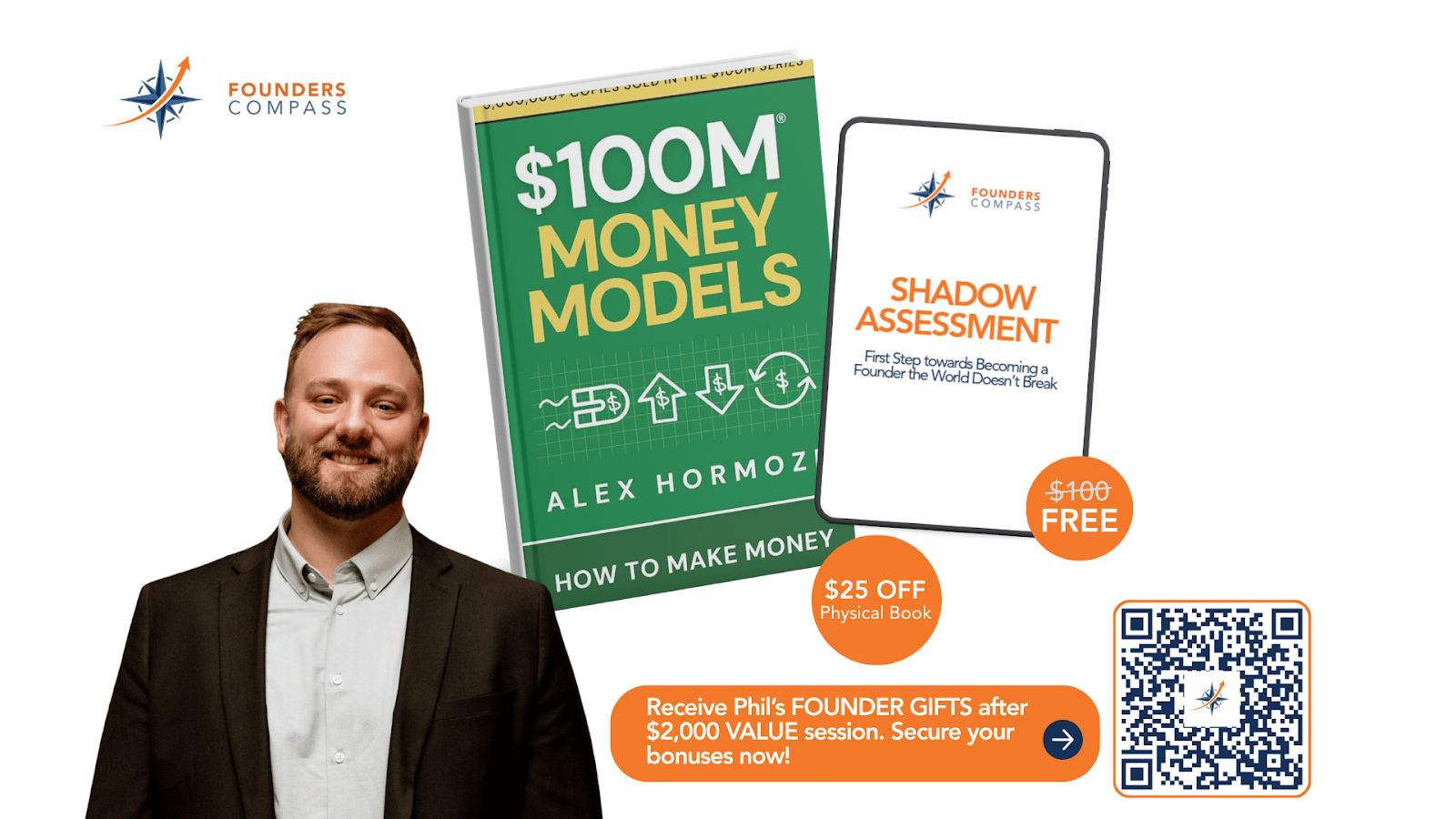
Phil Neil Founder Compass bonus session and Shadow Assessment
These weren’t endpoints.
They were a bridge.
A way to move from insight into practice without overwhelming an already-full life.
The 90-Day Challenge
For founders stepping into 2026, the next phase is a 90-day challenge grounded in consistency—not intensity.
“It’s like going to the gym—adapted to a founder’s real schedule.”
It focuses on four capabilities that reinforce one another over time:
Calm, so pressure doesn’t hijack judgment
Clarity, so decisions aren’t made from cognitive fog
Conviction, so founders can distinguish signal from noise
Cadence, so performance is sustainable instead of extractive
These capabilities aren’t meant to be developed in isolation.
Calm creates space for clarity.
Clarity enables conviction.
Conviction allows for a cadence that doesn’t burn the system down.
This isn’t about becoming unshakeable or immune to stress.
It’s about becoming self-led—especially when conditions are uncertain and there’s no obvious right answer.
A Broader Space for Reflection: TEDxHarvardSquare 2026
These same themes will carry into the TedXHarvardSquare 2026, a natural complement to this work.
Founders examine how their decisions, values, and inner state will shape the future they’re building.
This is not as a conference to consume—but as a space to reorient.
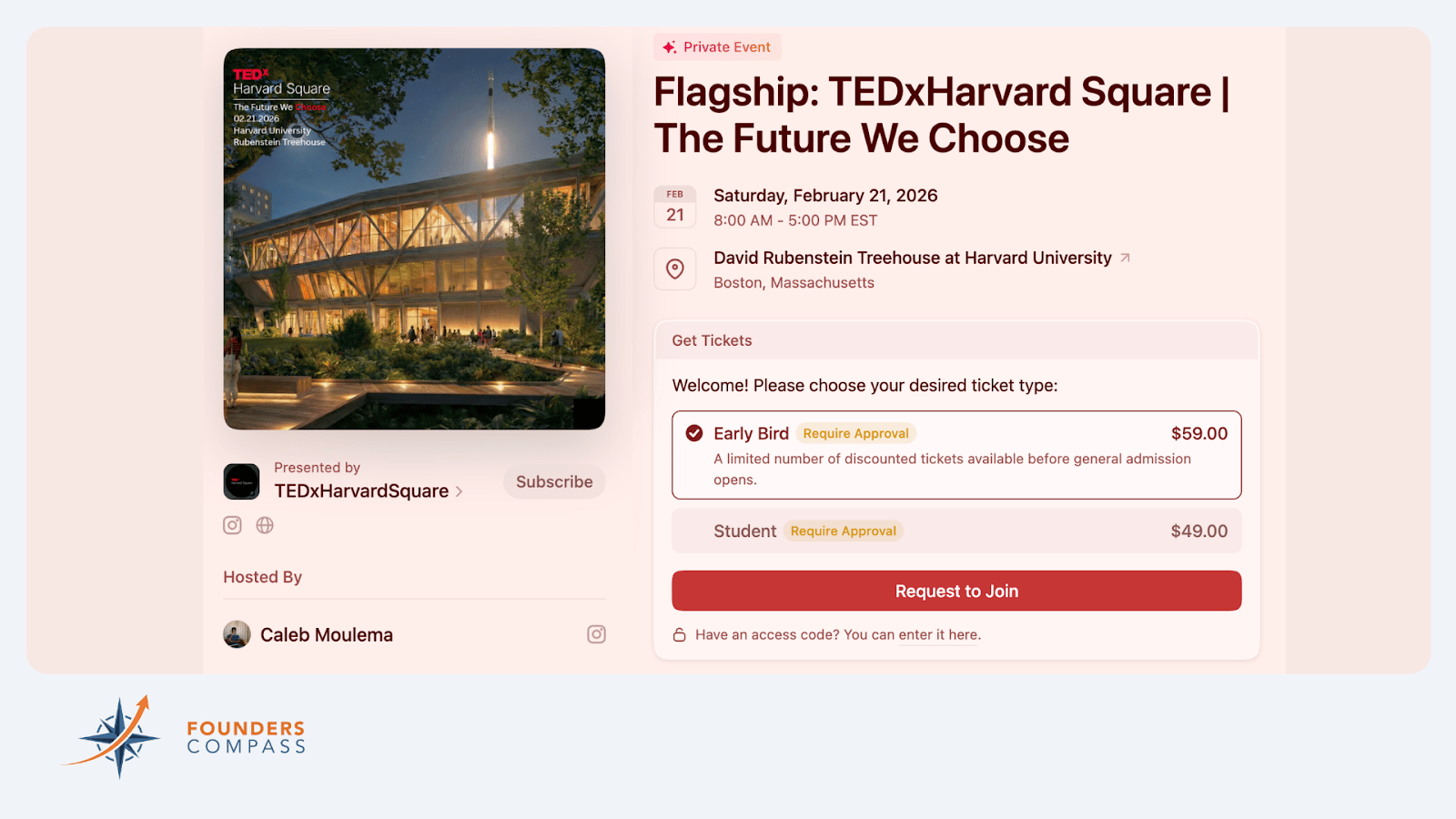
Inline image ord: TEDxHarvardSquare Flagship 2026 ticket page at Harvard University
On February 21, 2026, the TEDxHarvardSquare Flagship returns to the Harvard University Rubenstein Treehouse, convening founders, investors, researchers, technologists, and creators. The guiding question:
What future will we choose to build?
For founders, this question isn’t abstract.
It shows up daily—in hiring decisions, product direction, capital strategy, and how pressure is handled when there’s no clear answer.
As Phil Neil put it during the session:
“The only real protection founders have is sustaining decision quality under pressure.”
TEDxHarvardSquare is designed to create the kind of environment where that reflection can happen intentionally.
Through TEDx talks, discovery sessions, interactive workshops, startup showcases, and curated gatherings, the event invites participants to slow down just enough to examine how leadership, responsibility, and long-term impact intersect in a rapidly changing world.
In that sense, TEDxHarvardSquare supports the same principle explored throughout the Founder Compass conversation:
Strong companies are built by founders who know when to act—and when to pause.
🎟️ TEDxHarvardSquare 2026 details:
https://luma.com/zkv4w3w1
Final Reflection: What It Really Means to Be an Unbreakable Founder
Unbreakable does not mean fearless.
It does not mean certain.
And it does not mean always winning.
An unbreakable founder is someone who can pause, recalibrate, and choose how they respond—especially when pressure doesn’t let up.
Startups don’t usually fail in dramatic moments.
They erode quietly—through exhausted decisions and unexamined patterns, As Phil shared:
“The gap between how you showed up and how you wanted to show up—that’s your opportunity to grow.”
While founders learn how to pitch, scale, and optimize, being the leader their team needs to scale and operate cohesively through the struggles requires intentional time spent to learn how to
Regulate pressure
Recognize emotional patterns
Separate noise from signal
Build a cadence they can actually sustain
If, as you look toward 2026, you’re unsure whether you trust your decision-making under pressure—that’s not a failure.
It’s a starting point.
Because becoming unbreakable isn’t a moment.
It’s a practice.
And it begins by choosing to lead—from the inside out.
Continue the Conversation: Resources & Next Steps
If this conversation resonated, here are ways to explore it further—at your own pace:
🎧 Watch the Full Founder Compass Podcast
🧭 Explore the Founder Compass Path
Learn more about the 90-Day Challenge and the inner operating system it’s designed to build
Access the Shadow Assessment
Continue the work on calm, clarity, conviction, and cadence as you step into 2026
(Links shared directly with participants and subscribers)
________
Add this in the comments, not the newsletter/blog
🎤 Join the Broader Founder Conversation
TEDxHarvardSquare 2026 — February 21, 2026
https://luma.com/zkv4w3w1
📩 Subscribe to The Unbreakable Founder Newsletter for:
Reflections and insights from Founder Compass conversations
Practical frameworks for leading under uncertainty
Early access to future sessions, challenges, and events